Draft 1
1. What’s unexpected about this thing you just made?
The unexpected part is how much control small adjustments in parameters have over the final image. I initially thought the process would be more straightforward, but even tiny changes in contrast or symbol density can dramatically affect the readability of the ASCII art. Another surprising aspect is how different symbols, when placed together, create an illusion of shading and depth, even though each character is just a simple shape on its own.
2. What do you understand better or differently about your tool or medium now?
I now see ASCII art not just as a form of image rendering but as a system of abstraction that relies on perception and recognition. The process of converting images into characters isn’t just about mapping tones—it’s about balancing structure and meaning. I also better understand how P5.js can be used to automate and manipulate this process, but with room for creative intervention.
3. Did it pose a particular technical challenge?
Yes, one key challenge was maintaining the recognizability of the object while using a limited set of symbols. If the distribution was too sparse, the image lost its form; if it was too dense, it became unreadable. Another challenge was adjusting contrast levels—what works for one image doesn’t necessarily work for another, requiring constant tweaking.
4. What kind of output or knowledge does this tool or medium favor?
ASCII art prioritizes abstraction over realism, focusing on contrast, shape, and distribution rather than fine detail. It favors a minimalist approach where meaning emerges from patterns rather than precise depiction. This medium also emphasizes constraints as a creative tool, as it forces the user to think about how to represent complex visuals with a very limited set of elements.
5. What relationship does it have to graphic or communication design?
ASCII art bridges the gap between text and image, making it relevant to graphic communication design. It challenges traditional modes of representation and explores how symbols function visually and linguistically. This process also relates to the broader idea of designing with constraints—working within a system (like ASCII characters) to create something visually compelling. Additionally, its accessibility and adaptability to different digital contexts make it an interesting tool for experimental design and digital aesthetics.
Draft 2
In the code I wrote last week, character density was generated by mapping pixel brightness, and character colors were restored based on the RGB values of the image. These conditional settings ensured clear design logic and predictable outputs, allowing the ASCII art to reproduce the basic visual information of the image.
In Conditional Design Workbook, it is stated that rules should not only be seen as limitations but also as tools to inspire creativity and change. This idea challenges the traditional belief that “rules equal restrictions” and instead highlights the generative and open-ended role of rules in design.
Based on this, I adjusted the generation rules. For example, when the logic for choosing characters shifted from brightness mapping to random distribution, the design moved away from the goal of precise image reproduction, creating more accidental and abstract visual forms. Similarly, the intervention in the color logic—through random RGB adjustments—introduced new color relationships to the image.
In this process, the arrangement of characters became a kind of “visual language,” detached from traditional symbolic logic. This made me wonder: do characters need to rely on language systems to have meaning, or can they break free from their original function and create new meanings through novel combinations?
Additionally, I reflected on the role of technology in design. By introducing randomness, I broke the logic of precision and predictability. This randomness brought unexpected results, raising the question: is the value of technology only about efficiency and certainty, or can “imperfection” also inspire creative outcomes?
- Maurer, L., Paulus, E., Puckey, J. and Wouters, R. (2013). ‘Conditional Design Manifesto’. In: Conditional Design Workbook.
Draft 3
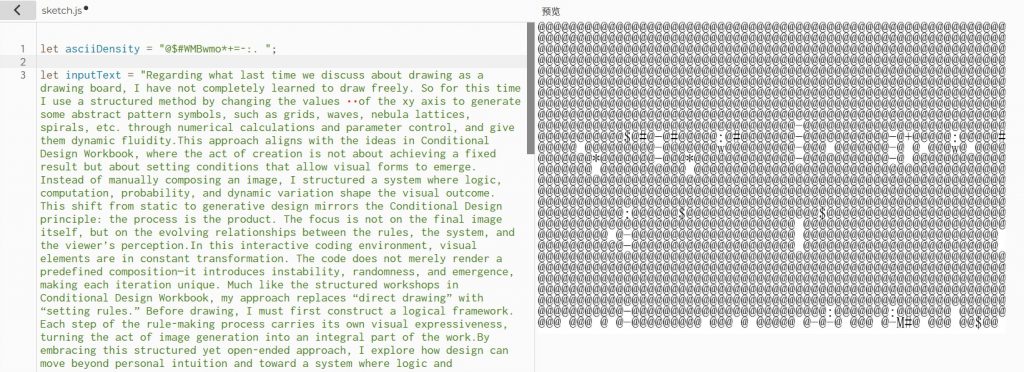
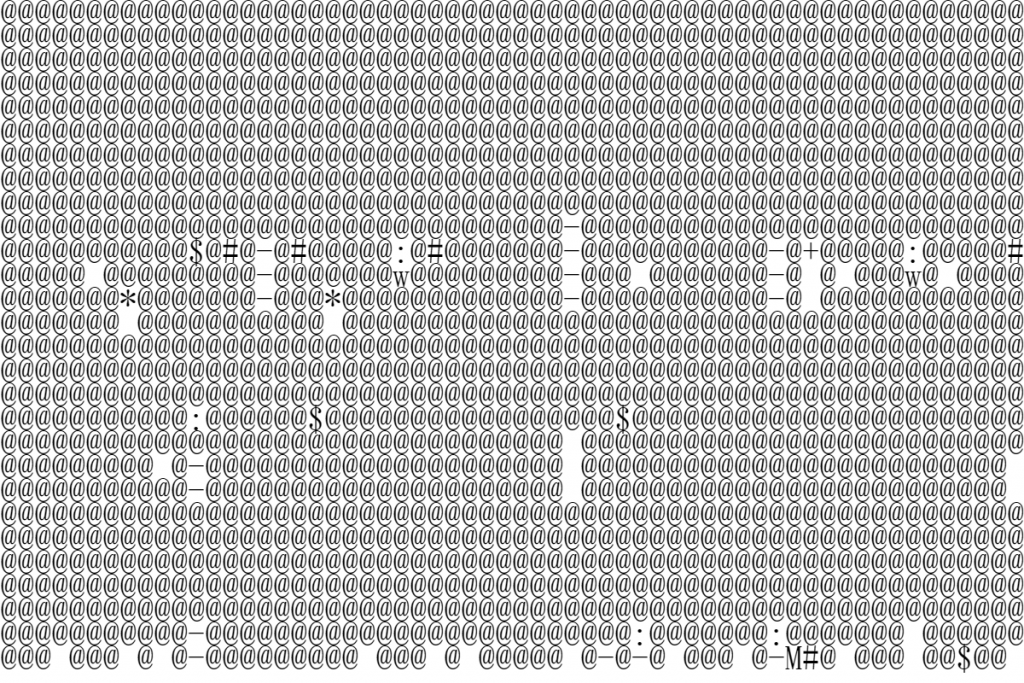
Regarding what last time we discuss about drawing as a drawing board, I have not completely learned to draw freely. So for this time I use a structured method by changing the values of the xy axis to generate some abstract pattern symbols, such as grids, waves, nebula lattices, spirals, etc. through numerical calculations and parameter control, and give them dynamic fluidity.
This approach aligns with the ideas in Conditional Design Workbook, where the act of creation is not about achieving a fixed result but about setting conditions that allow visual forms to emerge. Instead of manually composing an image, I structured a system where logic, computation, probability, and dynamic variation shape the visual outcome. This shift from static to generative design mirrors the Conditional Design principle: the process is the product. The focus is not on the final image itself, but on the evolving relationships between the rules, the system, and the viewer’s perception.
In this interactive coding environment, visual elements are in constant transformation. The code does not merely render a predefined composition—it introduces instability, randomness, and emergence, making each iteration unique. Much like the structured workshops in Conditional Design Workbook, my approach replaces “direct drawing” with “setting rules.” Before drawing, I must first construct a logical framework. Each step of the rule-making process carries its own visual expressiveness, turning the act of image generation into an integral part of the work.
By embracing this structured yet open-ended approach, I explore how design can move beyond personal intuition and toward a system where logic and unpredictability coexist. This project is an experiment in shifting control—not seeking absolute precision, but instead allowing the conditions I set to lead to unexpected, ever-evolving forms.
- Maurer, L., Paulus, E., Puckey, J. and Wouters, R. (2013). ‘Conditional Design Manifesto’. In: Conditional Design Workbook