The text I chose is part 1 (p7-p17)
VISUAL APPEARANCE
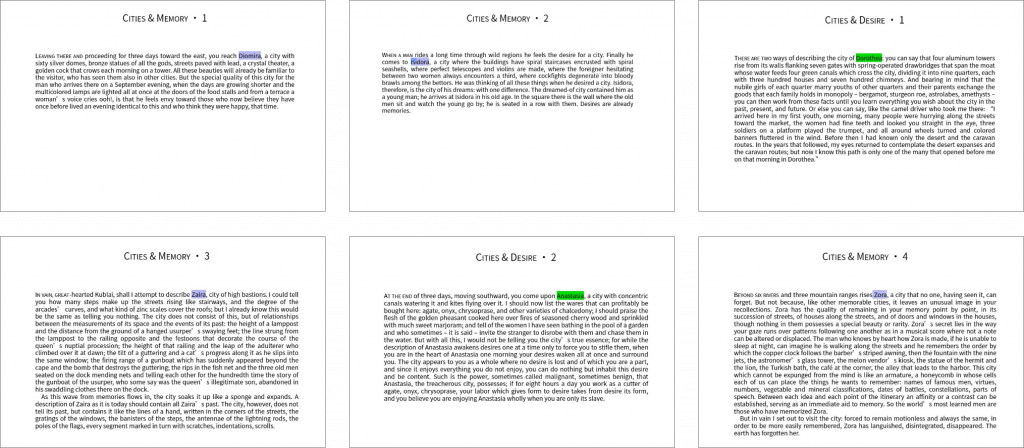
I found that Calvino left a lot of blank space at the end of each chapter. Combined with my personal experience when reading, I thought about the significance of such layout.
The blank space visually separates the description of each city from the previous and next paragraphs, and creates a sense of space through these pauses, as if each city is a “moment” or “fragment” existing in imagination.
The use of blank space in the reading process forms a slow reading rhythm. Every time a city is described, the blank space allows readers to pause naturally, so that they can immerse themselves in the understanding and imagination of the city.
The pause between each city is not only a visual rest, but also a transition in thought.
ARGUMENT
Argument 1: Cities as Carriers of Memory (eg: Diomira\Isidora\Zaira\Zora)
Calvino proposed that the city is not only a physical space, but also a gathering point of collective and personal memory, thus unfolding a network of memory interwoven with space, time and events. The old city in memory not only exists in memory and images, but is also a symbol of culture and identity. Through this argument, Calvino implies that people’s attachment to the city not only comes from its external form, but also lies in the emotional resonance and projection of memory of the past.
Argument 2: Cities carry human desires (eg: Dorothea\Anastasia\Despina)
Calvino believes that the creation of a city stems from a desire, and the architecture and layout of each city are the embodiment of people’s pursuit of a better life. However, the form of desire is not entirely subjective imagination. As a deposit of human activities, the city gives form to desire in its solidified form, or projects desire into a spatial form and at the same time in its spatial layout.
Argument 3: Signs and symbols in cities(eg: Temara\Zirma)
Calvino sees the city as a collection of symbols. Through the various symbols in his depictions, the city’s signs, landmarks, and buildings are not only functional, but also a kind of semiotic existence, representing a specific social culture, historical background or identity. Symbols are not custom-made clothes that can be put on and taken off, but a skin that grows and changes with the city, tightly adhering to the city’s muscles.
References:
- Calvino, I. (1974). Invisible Cities. Orlando: Harcourt Brace & Company. [Originally published 1972].